10 Things You Might Not Know About Rolling Rock Beer
10 Things You Might Not Know About Rolling Rock Beer
(Courtesy Anheuser-Busch)
As with many cult beers, Rolling Rock has always carried a little mystery with it. The green bottle is instantly recognizable. The horse logo stands out. Then there is that famously strange “33” printed on every label, which has fueled more barroom theories than perhaps any number in beer history.
And not unlike many craft beers, Rolling Rock has built a devoted following through its quirks, tradition, and a slightly offbeat personality. And here are ten things you might not know about the famous pale lager.
Rolling Rock was born in Pennsylvania horse country
Rolling Rock was first brewed by the Latrobe Brewing Company in Latrobe, Pennsylvania. The town sat in western Pennsylvania farm country, where horse racing and riding culture played a big role in local life. That explains the horse imagery that became part of the brand’s identity.
The horse head logo was not random marketing. It reflected the local culture and gave Rolling Rock a distinct personality from the start.
Rolling Rock is famous for its small retro bottles
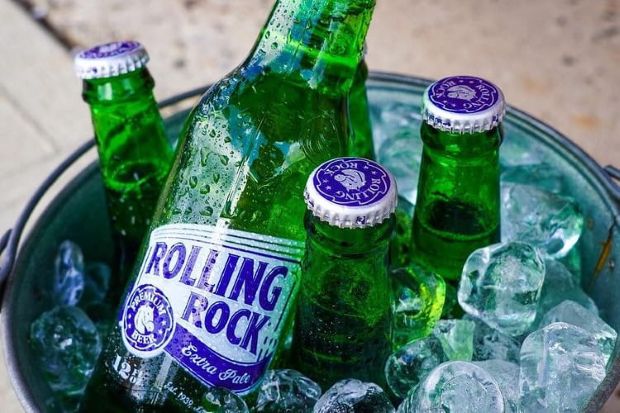
Rolling Rock is currently available in most modern configurations, its small embossed bottles are legend.
While many macro beer brands have moved away from smaller packaging sizes, Anheuser-Busch continues to distribute Rolling Rock’s famous 7-ounce “pony” bottles, (a nickname that dates back to 19th-century’s diminutive “pony glasses”), but they’re not quite the same the originals.
Original pre-2000s pony bottles featured heavily embossed, raised text and textures molded directly into the glass. Modern iterations use the much cheaper smooth glass with baked-on enamel graphics.
They retain the classic, bright green vintage look with the white paint-screened horse head graphic on the front and the “33” pledge on the back.
Nobody fully agrees on what the “33” means
The mystery of Rolling Rock’s number has become beer folklore.
Theories have included that there were 33 words in the brewery’s quality pledge. Others claimed the beer recipe had 33 steps. Some said a horse race winner wore number 33. One story even suggested that the brewery’s printer accidentally charged for 33 words and the owners simply left the number there.
The brewery itself has occasionally played along with the mystery instead of completely shutting down speculation. At this point, the uncertainty may be more valuable than the actual answer.
Rolling Rock’s famous pledge appeared right on the bottle
Rolling Rock bottles long carried a quality statement that many drinkers could probably recognize on sight:
“From the glass lined tanks of Old Latrobe…”
For years, the pledge became part of the beer’s identity. Even people who had no idea where Latrobe was often remembered seeing that text.
It felt less like marketing copy and more like a declaration from another era.
Its glass lined tanks became legendary
The brewery heavily promoted its use of glass lined tanks for brewing and storage.
The idea was that glass lining prevented metallic flavors and maintained beer purity. Whether drinkers could actually taste the difference became a matter of debate, but the phrase itself became part of Rolling Rock mythology.
And beer fans repeated it for decades.
The beer developed a surprisingly loyal cult following
Rolling Rock never reached the massive heights of some domestic lagers, but it earned something arguably more interesting: passionate fans.
By the 1970s and 1980s, the beer had become especially popular in parts of the Northeast and Mid-Atlantic. College students embraced it. Bar owners stocked it. People developed regional loyalty to the green bottle.
Its icon green bottle still helps Rolling Rock stand out
Beer shelves can become a blur of brown bottles and aluminum cans. Rolling Rock’s green bottle helped separate it from the crowd.
Of course, green bottles have long had a downside because they let more light hit the beer, potentially causing skunky flavors. But visually, Rolling Rock looked distinctive and memorable.
Sometimes branding wins and clearly Rolling Rock’s branding does.
The has brewery changed hands several times
Rolling Rock was produced by the Latrobe Brewing Company from 1939 until 1985 when it was sold to the Sundor Group.
Then it was sold to Labatt U.S.A. in 1987.
Then Labatt was purchased in 1995 by the Belgian brewing conglomerate Interbrew, which merged later into InBev in 2004.
Anheuser-Busch purchased the Rolling Rock brands from InBev in 2006.However, in 2008, InBev acquired Anheuser-Busch and formed Anheuser-Busch InBev SA/NV
Fans once protested the brewery’s move
The move out of Latrobe did not exactly go quietly.
Residents and loyalists viewed Rolling Rock as more than a beer. And its identity was rooted in Latrobe. Some fans organized protests and voiced frustration over production leaving the town where the brand had started nearly seven decades earlier.
Beer loyalty can run deep, especially when hometown roots are involved.
Rolling Rock still feels like a retro beer
In today’s craft beer world, drinkers are awash with options, from hazy IPAs to fruit infused sours, imperial stouts and barrel aged experiments .
Rolling Rock remains relatively simple. And no matter what think of mega-brewers, you’ve got to give Anheuser-Busch credit for understanding this beer and its legacy.
It is a straightforward American lager with a recognizable bottle and a mysterious number that still sparks conversations. And in a beer industry constantly chasing the next big thing, there is something refreshing about a brand that still leans into its own odd little history.
###
Want more “10 Things”?
We’ve got ‘em…
10 Things You Might Not Know About Shiner Beer
10 Things You Might Not Know About Firestone Walker Brewing
10 Things You May Not Know About Budweiser
10 Things You Might Not Know About Sierra Nevada Brewing
10 Things You Might Not Know About Dogfish Head Craft Brewery
About the Author: American Craft Beer

Get Social
Join Our Newsletter