BrewDog: From Punk Pioneer to Corporate Cautionary Tale
BrewDog: From Punk Pioneer to Corporate Cautionary Tale
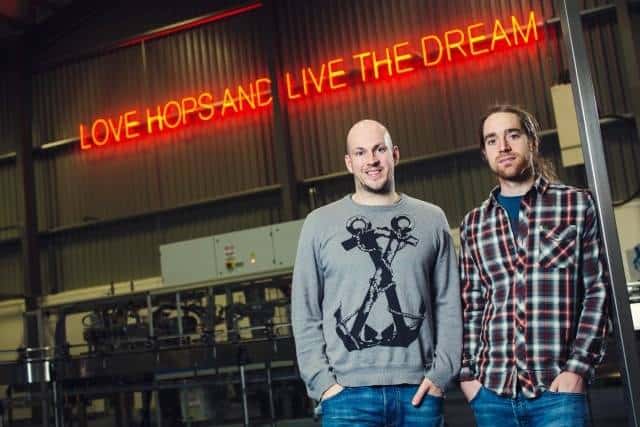
(BrewDog Founders James Watt and Martin Dickie)
The story of BrewDog is one of the most dramatic arcs in modern craft beer: a rebellious Scottish startup that rocketed from garage operation to global powerhouse on bold marketing, crowdfunding innovation, and relentless expansion — only to crash amid scandal, mounting losses, and a fire-sale acquisition by Tilray Brands.
Punk Beginnings
BrewDog was founded in Fraserburgh, Scotland, by James Watt and Martin Dickie, who saw the British beer scene as bland and corporate. Their answer was aggressive, high-octane American-style IPAs packaged with confrontational marketing and a DIY ethos.
From the start, BrewDog wasn’t just selling beer — it was selling attitude. The company branded itself “Punk,” a word that would define its flagship beer, Punk IPA.
The approach worked. Early releases like Tactical Nuclear Penguin — once billed as one of the world’s strongest beers — grabbed international headlines as BrewDog cultivated an image as the enfant terrible of brewing, gleefully thumbing its nose at convention.
Equity for Punks
In 2009, BrewDog launched “Equity for Punks,” a pioneering crowdfunding model that allowed fans to buy shares in the company. Long before equity crowdfunding became commonplace, BrewDog turned customers into investors — and evangelists.
The model fueled rapid expansion. New breweries opened in Ellon, Scotland, and later in Columbus, Ohio. BrewDog bars multiplied across Europe and the United States. By the mid-2010s, BrewDog was one of the fastest-growing craft breweries in the world.
In 2017, private equity firm TSG Consumer Partners took a significant minority stake, valuing the company at £1 billion. For a brewery that built its brand on anti-corporate swagger, the deal raised eyebrows — but it also provided capital to chase global ambitions.
From Rebel to Empire
With fresh funding, BrewDog expanded aggressively into Asia and Australia, opened a sprawling brewery and taproom complex in Ohio, and even launched the “DogHouse” craft beer hotel concept in both the U.S. and the U.K.
The company positioned itself as the world’s leading craft beer brand. Watt became a high-profile entrepreneur, frequently appearing in media interviews and on television. BrewDog’s valuation soared. So did its footprint.
But growth at that pace came at a cost.
Culture Under Fire
In 2021, a group of former UK employees published an open letter alleging a toxic workplace culture, accusing leadership of fostering fear, burnout, and unrealistic expectations. The letter quickly gained traction in British media.
Watt publicly apologized, acknowledging shortcomings in management and pledging reforms. BrewDog commissioned reviews of its workplace practices and promised cultural changes.
For critics, however, the controversy underscored what they saw as a contradiction at the heart of BrewDog: a brand built on inclusivity and community that struggled internally under the pressures of hypergrowth.
Craft Beer Cools
By the early 2020s, the broader craft beer market had cooled. Pandemic disruptions, rising costs, and shifting consumer tastes squeezed margins. Hard seltzer booms fizzled. Non-alcoholic options gained ground. Inflation tightened wallets.
BrewDog, heavily leveraged to expansion and global infrastructure, felt the strain. Bar closures and restructuring followed in several markets. Ambitious sustainability pledges — including becoming carbon negative — remained part of the brand narrative, but profitability pressures mounted.
What once looked like unstoppable momentum began to reek of serious overextension.
Co-founders Exit
In May 2024, James Watt — long the face and driving personality of the company — stepped down as CEO. Though he transitioned to a newly created non-executive role titled “Captain and Co-Founder,” the move effectively marked his exit.
Watt’s departure was followed by Martin Dickie in August 2025. Citing personal reasons, Dickie said he wanted to spend more time with his young family. Like Watt, he remains a shareholder but holds no active role in the business.
Cannabis Company Acquires BrewDog
By February 2026, BrewDog had entered administration — the UK equivalent of bankruptcy protection — and no buyer emerged to preserve the company in full.
On March 2, Tilray Brands, which already owns a portfolio of craft beverage properties, acquired key assets for £33 million (about $44 million) — a fraction of the company’s former valuation.
The deal included the global brand, intellectual property, UK brewing operations in Ellon, and 11 strategic brewpubs in the UK and Ireland, preserving approximately 733 jobs. However, 38 additional bars closed.
The sale marked the end of BrewDog as an independent “punk” force. Once hailed for challenging the industry with innovation and community-driven growth (its Equity Punks), has become a cautionary tale of hubris, overexpansion, reputational damage, and the limits of hype-fueled ambition.
###
Want more on the BrewDog saga?
We’ve got ‘em…
BrewDog Admits To Mistakes That Breached US Import Law
About the Author: American Craft Beer