What the Hell Is a Cask Ale?
What the Hell Is a Cask Ale?
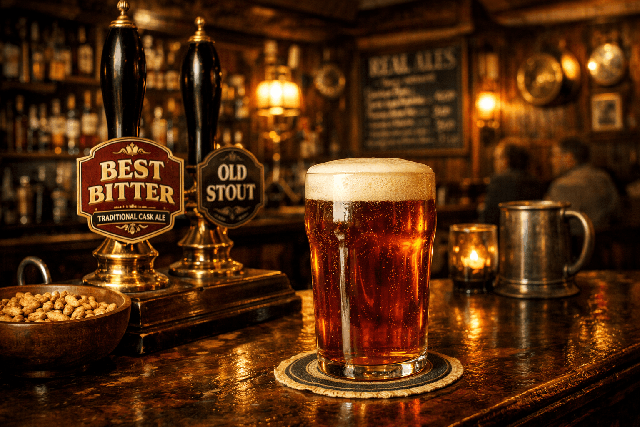
Walk into the right pub in London, or Manchester, and you might see a hand pump on the bar with a small chalkboard label: Best Bitter – Cask. No CO₂ tank in sight. No shiny tap handle. Just a wooden or metal handle that looks like it belongs on an old farm tool.
That’s cask ale. And if you’ve never had one, you’re missing out on one of beer’s most quietly glorious traditions.
The Basics
Cask ale, often referred to as “Real Ale: isn’t a specific kind of beer like IPA or stout. It’s a method of serving beer. Almost any traditional British-style beer — bitter, mild, pale ale, porter — can be served on cask. What makes it different is how it’s conditioned and poured.
Cask ale undergoes a secondary fermentation inside the very container it’s served from — the cask. The brewer adds a little extra yeast and sugar before sealing it up. As the yeast finishes its work, it naturally carbonates the beer. No artificial gas. No forced carbonation. Just time, yeast, and patience.
When the cask arrives at the pub, it’s vented, tapped, and left to settle. Then it’s served via a hand pump (called a beer engine) or sometimes directly from the cask.
Key Characteristics
Cask ale is naturally carbonated, but at a much lower level than most American draft beers. That means softer bubbles. Less bite. More focus on flavor.
It’s also served at “cellar temperature” — usually around 50–55°F. Not warm, despite what skeptics like to think. Just not ice-cold. That slightly warmer temp lets the malt character, hops, and yeast complexity show up in ways they can’t when beer is served straight from a near-freezing tap.
Because cask ale isn’t force-carbonated and isn’t sealed under high pressure, it’s more fragile than typical keg beer. Once tapped, a cask usually needs to be finished within a few days. After that, it starts to oxidize and lose its bright freshness.
That’s part of the charm. Cask ale is a living product. It demands care from the pub staff. It rewards turnover. It encourages regulars. In the UK, there’s even an organization — CAMRA (the Campaign for Real Ale) — devoted to preserving and promoting it. For many drinkers, cask ale isn’t just beer. It’s culture.
And cask ale requires cellar skills. You can’t just hook it up to a gas line and forget about it. The pub has to store it properly, vent it at the right time, let it settle, and sell it quickly. That’s not always practical in high-volume, tap-heavy craft bars.
Notable US Cask Producers & Locations
 Finding properly maintained cask ale can be challenging in the US but certain breweries and bars specialize in the craft:
Machine House Brewery (Seattle, WA): Specializes almost exclusively in traditional English-style real ales.
Hogshead Brewery (Denver, CO): A dedicated producer of British-style cask ales since 2012.
ChurchKey (Washington, D.C.): Known for its extensive craft beer offerings, this DC legend regularly features multiple dedicated cask lines.
Dutchess Ales (Wassaic, NY): Recreates traditional cask-conditioned ales inspired by British heritage
Bottom Line
Cask ale is beer the old way: naturally conditioned, gently carbonated, served at cellar temp, and handled with care. It’s less about spectacle and more about craft.
If you love crisp, high-carb West Coast IPAs, beers that snap and sparkle, cask ale might feel subdued. But if you appreciate balance, drinkability, and subtle depth, it can be a revelation.
A cask ale isn’t flashy. It’s a conversation beer. A second-pint beer. A sit-by-the-fire-and-let-the-world-slow-down beer.
And in a craft scene that sometimes chases the loudest possible outcome, that kind of restraint can be welcome.
###
About the Author: American Craft Beer