5 American Craft Beers That Defined A Movement
5 American Craft Beers That Defined A Movement
The craft beer movement wasn’t created by any single brewery or beer. It grew out of homebrewing, old world traditions and visionary entrepreneurs who gambled that American beer fans might embrace something more authentic.
But some beers changed things more than others.
Here are five beers that helped define the craft beer movement as we know it today.
And each one of these brews was honored as an inaugural Landmark Beer by the American Craft Beer Hall of Fame in August 2025.
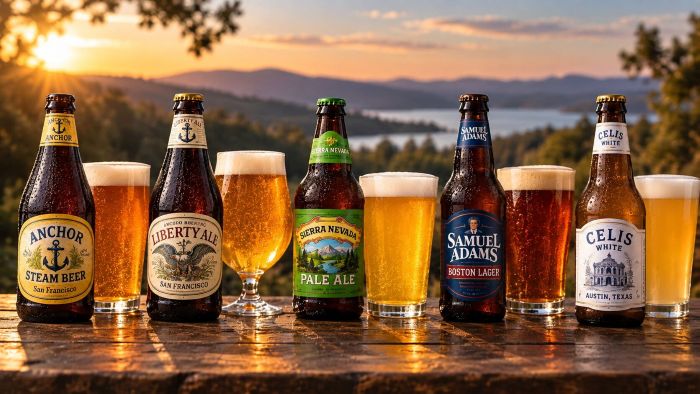
Anchor Steam Beer
One of America’s few indigenous beer styles, Anchor Steam Beer was a first for the fledgling craft beer industry, a hybrid beer style that famously ferments lager yeast at warm ale temperatures.
When Fritz Maytag purchased San Francisco’s struggling Anchor Brewing in 1965, American brewing was deep in the doldrums. Small regional breweries were disappearing or being incorporated into the majors, and the future almost entirely dominated by national brands.
Maytag went the other way, that’s what visionaries do.
He improved Anchor’s brewing practices and embraced the brewery’s unusual Steam Beer, a distinctly Californian creation made using lager yeast fermented at warmer temperatures. The beer eventually became synonymous with Anchor and helped demonstrate that an old regional brewing tradition could find a new audience.
Anchor Steam wasn’t flashy by modern standards. That was never the point. It proved that a small American brewery could survive by being different rather than trying to imitate the giants.
Much of what followed in craft brewing began with that simple idea.
Anchor Liberty Ale
If Anchor Steam helped establish the philosophy behind American craft beer, Liberty Ale helped establish its flavor.
Originally brewed in 1975 to commemorate the 200th anniversary of Paul Revere’s ride, Liberty Ale made unusually prominent use of Cascade hops, giving drinkers a glimpse of the citrusy, aromatic character that would eventually become one of American craft beer’s signatures.
At the time, nobody could have known where that road was headed.
Today IPA is so deeply embedded in American craft beer culture that breweries can release multiple versions of the style without anyone blinking. West Coast IPA, hazy IPA, double IPA, session IPA and countless variations now occupy tap handles and cooler shelves across the country.
Liberty Ale arrived before all of that.
It wasn’t simply a hoppy beer. It was an early indication that American hops could give American beer an identity of its own.
Sierra Nevada Pale Ale
If Liberty Ale opened the door to American brewing possibilities, Sierra Nevada Pale Ale kicked it wide open
Ken Grossman and Paul Camusi founded Sierra Nevada Brewing in Chico, California, in 1980, and their Pale Ale became the beer that introduced countless drinkers to the unmistakable personality of Cascade hops.
The beer was bitter, aromatic and assertive, yet balanced enough that people kept coming back to it. And that combination proved enormously influential.
A multi-award-winning Sierra Nevada Pale Ale helped define what an American pale ale could be, and its hop-forward approach became a blueprint for generations of brewers.
There are beers that become successful, and there are beers that become reference points. Sierra Nevada Pale Ale became both.
Samuel Adams Boston Lager
By the middle of the 1980s, craft beer had pioneers. What it desperately needed was fans. Samuel Adams Boston Lager helped create them.
Jim Koch founded the Boston Beer Company in 1984 after resurrecting a family beer recipe, and Boston Lager made its public debut in 1985 at Boston-area bars and restaurants. Soon afterward, it was named Best Beer in America at the Great American Beer Festival.
But Boston Lager’s greatest contribution wasn’t winning awards. It was creating a full-flavored American beer that was approachable to people who didn’t necessarily think of themselves as craft beer drinkers.
For millions of Americans, Boston Lager became the ultimate gateway beer.
Celis White
Not every beer that shaped American craft brewing was built around American hops. Some expanded the movement by looking to Europe’s brewing traditions and giving them an American craft beer touch.
Pierre Celis had already helped revive Belgium’s nearly extinct Witbier tradition when he eventually brought his brewing knowledge to Austin, Texas, where Celis White introduced many American drinkers to a cloudy Belgian-style wheat beer flavored with spices and citrus.
And most of these beers are still around.
First released more than 45 years ago, Sierra Nevada Pale Ale is still widely available today. Ken Grossman famously dumped about 10 test batches before perfecting the recipe. When it was first introduced, its bitterness and intense aromas shocked the American palate—Grossman recalls that 90% of early tasters initially hated it. However, the 10% who loved it became apostles for the beer and craft beer’s potential.
Samuel Adams Boston Lager is still widely available in 2026. In 2023, the brewery introduced a subtly remastered version of the classic beer. By modifying the filtration and brewing process, they created a slightly brighter, smoother, and easier-drinking variant designed to reduce the heavier sediment of the original recipe while preserving its foundational malt and hop flavors.
Today, the beer remains the flagship offering of the Boston Beer Company, which still operates its historic research and innovation taproom at the Samuel Adams Boston Brewery in Jamaica Plain, Massachusetts.
Celis White is still around. The brand changed hands and closed for a period after corporate acquisitions. However, in 2017, Pierre’s daughter, Christine Celis, successfully reopened Celis Brewery in Austin. She brought back her father’s original proprietary Belgian yeast strain (which had been safely preserved in a Belgian lab) to ensure the beer tastes exactly as it did in 1965, and that’s where you can find it today.
Anchor Steam and Liberty Ale remain unavailable. In 2024, Anchor Brewing was purchased by Hamdi Ulukaya, the billionaire founder and CEO of Chobani, who announced plans to revive the historic San Francisco brewery. Work toward that revival appears to be underway, although Anchor has yet to announce when its beers will officially return.
Thousands of breweries and countless beers have followed in the wake of these ground-breaking brews.
But all movements need starting points, and these beers have made a lasting impact on the American craft scene that still resonates today.
###
And while we’re at it there’s this…
10 Classic American Beers That We Wish Were Still Around
About the Author: American Craft Beer

Get Social
Join Our Newsletter