5 More American Craft Beers That Defined A Movement
5 More American Craft Beers That Defined A Movement
The craft beer movement wasn’t created by any single brewery or beer. It grew out of homebrewing, Old World traditions and visionary entrepreneurs who gambled that American beer fans might embrace something more authentic.
But some beers changed things more than others.
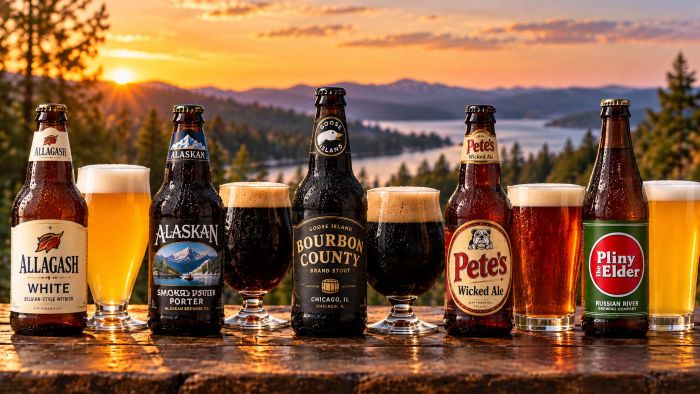
Here are five more beers that helped define the craft beer movement as we know it today.
And each one of these brews was honored as a Landmark Beer by the American Craft Beer Hall of Fame in August 2026.
Allagash White Ale
When Rob Tod founded Allagash Brewing Company in Portland, Maine, back in 1995, Belgian-style beers were still largely unfamiliar to most American drinkers. But Tod wasn’t exactly playing things safe.
Rather than launching with a conventional pale ale, he introduced Allagash White, a cloudy Belgian-style Witbier brewed with wheat, coriander and Curaçao orange peel.
And at a time when clarity was considered a virtue in American beer, Allagash White looked different, tasted different and initially proved difficult to sell.
But that beer eventually became one of America’s most recognizable Belgian-style wheat beers, introducing countless drinkers to a brewing tradition that extended well beyond the hop-forward ales dominating the emerging craft scene.
Allagash White helped establish Belgian-inspired brewing as an important part of American craft beer culture.
Alaskan Smoked Porter
When Geoff and Marcy Larson founded Alaskan Brewing Company in Juneau in 1986, they drew inspiration from Alaska’s rich brewing history and its unique regional traditions. And two years later, they introduced a beer that would become one of the most celebrated specialty beers in American craft brewing.
First released in 1988, Alaskan Smoked Porter was inspired by traditional German smoked beers, but the brewery gave the concept a distinctly Alaskan twist.
Using malt smoked over local alder wood, the same wood commonly used to smoke salmon, Alaskan created a rich, dark porter with roasted chocolate character and an unmistakable smoky complexity.
And unlike most beers of its era, Alaskan Smoked Porter was designed to age, developing additional complexity as its intense smoky character mellowed over time.
The beer went on to win numerous national and international awards, helping establish Alaskan Brewing as one of the country’s most innovative early craft breweries.
And maybe more importantly, it demonstrated that American brewers could take traditional European styles and transform them using regional ingredients and their own brewing imagination.
Goose Island Bourbon County Stout
Today, bourbon barrel-aged beers are a fixture of American craft brewing. But in the early 1990s, the idea of aging a powerful imperial stout in used whiskey barrels was almost unheard of.
Then Chicago’s Goose Island Beer Company changed all that.
Founded in 1988 by John Hall, Goose Island was already becoming an important player in the emerging Midwest craft beer scene when brewmaster Greg Hall began experimenting with aging imperial stout in bourbon barrels.
The result was Bourbon County Brand Stout, which Goose Island dates to 1992, although historical research suggests the beer may have actually debuted in 1995.
Rich, powerful and intensely flavored, Bourbon County combined the roasted chocolate and coffee character of imperial stout with vanilla, oak and bourbon notes drawn from the barrels.
This stout changed everything. It helped popularize bourbon barrel-aging as a distinctly American brewing innovation, inspiring countless breweries to establish their own barrel-aging programs.
And even though Goose Island was acquired by Anheuser-Busch in 2011, Bourbon County’s influence on American craft brewing remains undeniable.
Pete’s Wicked Ale
Not every beer that changed American craft brewing survived the revolution it helped create. And Pete’s Wicked Ale is a perfect example.
Introduced in 1986 by Pete Slosberg, Pete’s Wicked Ale arrived when American beer drinkers were only beginning to discover that there were alternatives to the nation’s dominant light lagers.
A rich, dark amber Brown Ale with roasted malt character and a distinctive caramel sweetness, Pete’s Wicked Ale offered considerably more flavor than most mainstream American beers of its day.
Slosberg understood that the emerging craft beer movement needed everyday drinkers willing to try something different. Pete’s Wicked Ale helped create them.
For countless Americans, it was their first introduction to craft beer. But as competition intensified and consumer tastes changed, Pete’s struggled to maintain its momentum. The brand eventually changed hands and production ended in 2011.
Pete’s Wicked Ale may be gone, but its contribution to the American craft beer movement remains significant.
Russian River Pliny the Elder
Few American craft beers have achieved the legendary status of Russian River Pliny the Elder. And fewer still have helped define an entire beer category.
Russian River Brewing was established in 1997 by Korbel Champagne Cellars in Sonoma County, California, with Vinnie Cilurzo serving as brewmaster. He was already experimenting with aggressively hopped beers when he introduced Pliny the Elder in 1999.
Named after the ancient Roman naturalist who wrote about hops, Pliny the Elder became one of the defining examples of the emerging American Double India Pale Ale.
And at 8% ABV, Pliny delivered an intense combination of citrusy, piney hop character, assertive bitterness and a surprisingly balanced malt backbone. And it quickly developed a cult following.
Pliny the Elder helped establish the West Coast Double IPA as one of American craft brewing’s most influential styles, inspiring generations of brewers to push the boundaries of hop intensity.
Today, Pliny the Elder remains one of the benchmarks against which American Double IPAs are judged. And its influence can be found in countless hop-forward beers produced across the country.
Where These Beers Stand Today
Most of these beers are still around.
Allagash White remains the flagship of the Portland, Maine brewery and one of America’s most respected Belgian-style wheat beers.
Alaskan Smoked Porter continues to hold an important place in American specialty beer history, although its limited releases make it considerably harder to find than the brewery’s more widely distributed offerings.
Goose Island Bourbon County Stout remains an annual event, with new variations released each year and a devoted following that shows little sign of disappearing.
Russian River Pliny the Elder is still going strong, its reputation as one of America’s great Double IPAs firmly established.
Pete’s Wicked Ale is the exception. Discontinued in 2011, it remains a reminder that even enormously influential beers don’t necessarily survive the changing marketplace.
Thousands of breweries and countless beers have followed in the wake of these groundbreaking brews.
But all movements need starting points, and these five beers have made a lasting impact on the American craft scene that still resonates today.
###
And while we’re at it there’s this…
10 Classic American Beers That We Wish Were Still Around
About the Author: American Craft Beer